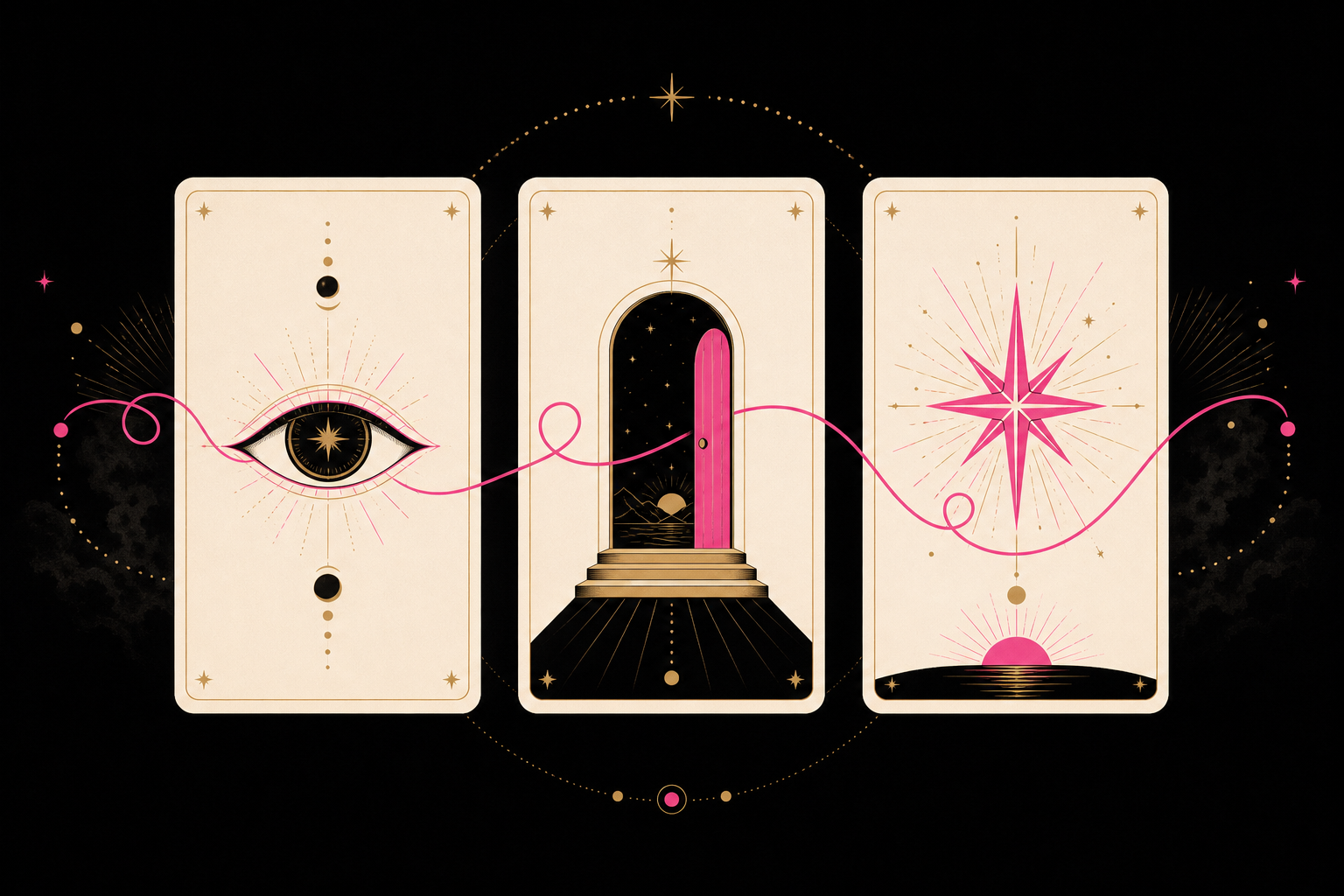
Three cards can tell a surprisingly complete story. The layout is quick enough for a regular practice, spacious enough for intuition and structured enough to stop a reading from drifting.
Past, present and future is only one way to use it. Give the positions a purpose before you shuffle, and the same three-card shape can answer dozens of different kinds of questions.
Past, present and future
Card one shows an earlier influence, card two describes the energy operating now and card three reveals where the current pattern may lead. The future card is not an unchangeable verdict. Treat it as a direction based on the energy and choices already in motion.
Situation, obstacle and advice
This is one of the clearest practical layouts. The first card names what is really happening. The second highlights friction, a blind spot or the belief keeping you stuck. The third suggests the most useful response.
You, them and the connection
For a relationship question, card one can explore your position, card two the other person’s energy and card three the dynamic being created between you. Keep the focus ethical: tarot can help you understand a connection, but it cannot grant access to somebody else’s private thoughts.
Mind, body and spirit
Use this spread as a personal check-in. What is occupying your thoughts? What is your body communicating? What does your deeper self need? It is especially useful when you feel “off” but cannot yet name why.
Option A, option B and your deciding factor
Tarot does not have to choose for you. Card one explores the energy around one route, card two explores the other and card three reveals the value, need or practical truth that should guide your decision.
Release, reclaim and rise
This empowering layout asks: what am I ready to stop carrying, what power or quality am I reclaiming, and what becomes possible when I act from that place?
Reading the cards as one message
Begin with each position, then zoom out. Notice whether the cards move from difficult to lighter energy, whether one suit dominates, whether several Major Arcana cards make the reading feel significant, or whether repeated numbers and symbols link the images.
Pay attention to the middle card. It often behaves like a bridge: the choice, tension or shift connecting the first card to the third.
When to pull a clarifier
Pull another card only when you can state exactly what needs clarification. “What aspect of this obstacle am I missing?” is useful. Repeatedly drawing until the deck gives you the answer you wanted is not clarification; it is negotiation.
Try your own three-card reading
Choose your positions, write them down and ask one clear question. Let the cards build a story rather than treating them as three unrelated definitions. You can use our three-card tarot reading or browse the complete tarot meanings library as you practise.
Leave a Reply