Author: BossWitch

  • How to Read Major Arcana Cards Together Without Forcing It

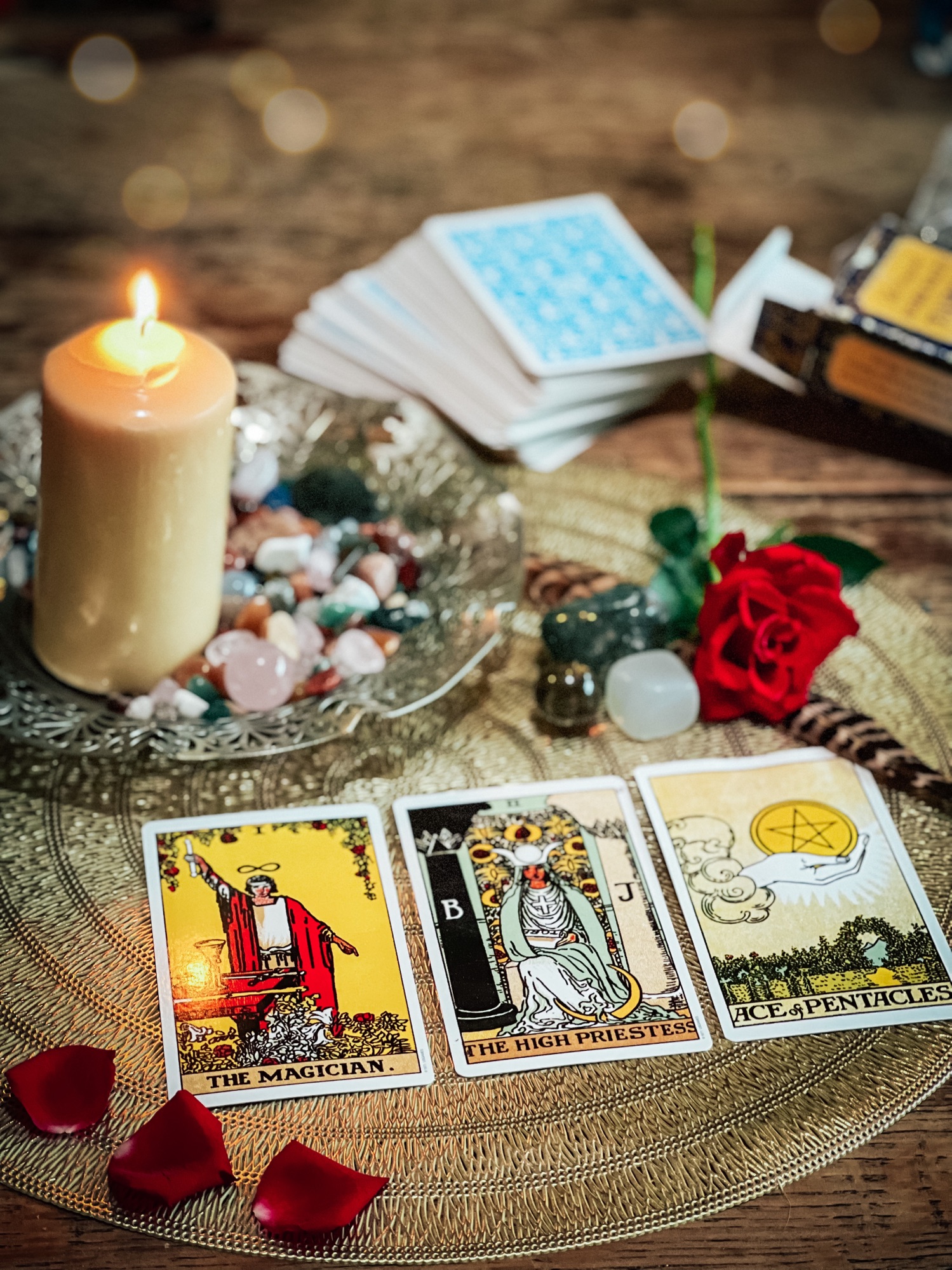
    A lit candle sits in a metal dish with crystals, wheat, and feathers. Three tarot cards—the Magician, the High Priestess, and Ace of Pentacles—are spread on a wooden surface.

    When several Major Arcana cards show up together, you do not need to announce a life-changing prophecy and panic everyone in the room. You need to notice the conversation the cards are having, then bring it back to real life.

    Learning to read Major Arcana together helps you move beyond isolated card meanings. A single Major card can point to a powerful inner theme, a pressure point or a turning point. Two or more can show how those themes rub up against each other: freedom versus responsibility, hope after upheaval, desire tangled with fear. This is not about predicting fate or finding one official answer hidden in the deck. It is about using the images and archetypes to ask better questions, see the pattern in front of you and choose your next move with a bit more nerve.

    What it means to read Major Arcana together

    The Major Arcana are the 22 cards from The Fool to The World. They deal in big human material: identity, change, relationships, conflict, desire, grief, courage, belonging and growth. That does not mean every Major Arcana-heavy spread signals an earthquake in your personal life. It may simply mean the question matters deeply to you, or that you are being asked to look at the underlying issue rather than the surface admin.

    To read Major Arcana cards together, treat each card as one voice in a small group chat. The cards may agree, challenge each other, describe a sequence or show an internal conflict. The Hermit beside The Chariot, for instance, may suggest a tension between taking private time to think and pushing ahead decisively. Neither card cancels the other out. Together, they ask what pace and direction would actually serve you.

    Start with the plainest possible statement. Name what each card represents before reaching for a dramatic interpretation. The Empress can speak of care, creativity, pleasure and abundance. Justice can speak of fairness, accountability and clear-eyed decisions. Put them together and you might ask: where does care need firmer boundaries, or where does a practical decision need more humanity?

    Start with the roles when you read Major Arcana together

    A reliable way to read Major Arcana together is to give every card a role. This stops you from throwing meanings into a mystical blender and hoping for the best. Look first at the spread positions, if you used them. A card in the “current situation” position does a different job from one in the “advice” or “likely direction” position.

    • First card: What is the central energy, issue or emotional weather?
    • Second card: Does it support, complicate, challenge or explain the first?
    • Third card: Is it a response, a consequence, a hidden factor or a useful approach?
    • Final card: What attitude, choice or lesson might help you handle the situation?

    If you pulled cards without assigned positions, make a simple structure yourself. Read from left to right as where you are, what is affecting it, what to consider next. You are not cheating by adding a bit of order. You are giving your brain a sensible rail to hold on to.

    Read Major Arcana pairs as a relationship, not a dictionary

    With a pair, ask what changes when the cards sit beside each other. The Fool and The Magician can suggest an idea moving from curiosity into capability. The Fool is willing to begin; The Magician has tools and knows how to use them. In practical terms, this might point to researching that course, sending the pitch or making a basic plan before taking a leap.

    The Lovers and The Devil offer a different sort of conversation. The Lovers can concern values, connection and meaningful choice. The Devil can highlight unhealthy attachment, shame, avoidance or the things that have more power over us than we would like. Together, they may ask whether a relationship, habit or commitment is aligned with your values, rather than simply familiar or exciting. No demon drama required.

    Use spread positions to read Major Arcana cards together

    Position is context, and context is half the reading. The same cards can say wildly different things depending on the question and layout. If Death appears as “what to release” and The Sun appears as “what becomes possible”, the spread may be encouraging an honest ending that creates room for clarity and energy. It does not promise that the ending will be painless, nor that sunshine will arrive by Tuesday. It suggests a useful direction for reflection.

    In a three-card spread, try reading the cards as a sentence. For example: Strength, The Tower, Temperance. A grounded reading might be: “Meet disruption with steadiness, then take time to rebuild balance rather than rushing to patch everything up.” Notice that this is an approach, not a forecast. It gives the reader something they can do if life feels wobbly.

    Read the Major Arcana sequence without treating it as a timetable

    The numbered order of the Major Arcana can add another layer. Lower-numbered cards often feel more like beginnings, experiments or early lessons; later cards can suggest integration, reckoning or completion. The Fool, numbered zero, may bring openness or a fresh start. The World, at 21, may point to completion, perspective or a cycle reaching its natural end.

    But do not turn the sequence into a rigid ladder. Human life is not a neat march from Fool to World with no backtracking, snacks or questionable decisions. The cards can show a psychological movement rather than a literal chronology. The High Priestess followed by The Emperor may describe intuition needing structure. The Emperor followed by The High Priestess may suggest that control needs to make room for inner knowledge.

    Read Major Arcana together by finding the tension and the thread

    Once you know each card’s basic role, look for two things: the tension and the thread. The tension is where the cards seem to pull in different directions. The thread is the shared concern running through them. Both are useful. A reading becomes specific when you can name the push and pull instead of flattening every card into a vague message about “transformation”.

    • Look at posture and direction: Are figures facing each other, looking away or moving forwards? The artwork may suggest engagement, avoidance or momentum.
    • Notice repeated symbols: Light, water, mountains, animals, crowns and paths can create a visual link between cards.
    • Compare the energy: Is one card active and one still? Is one about inner work and another about public action?
    • Ask what is missing: A spread full of authority, ambition and action may be asking where rest, support or emotional honesty has gone.

    Boss Witch Reality Check: A spread packed with Major Arcana does not mean you are uniquely cursed, chosen or one WhatsApp message away from destiny. It means the question has weight. Keep your feet on the floor and make tea before making any grand announcements.

    Say you pull The Chariot, The Hanged Man and Wheel of Fortune for a career question. The tension is obvious: push ahead, pause and surrender control, then accept change. The thread is your relationship with momentum. Rather than declaring a promotion inevitable, you could ask: where am I forcing progress, where would a strategic pause help, and what change can I prepare for without pretending I control every variable?

    Major Arcana combinations: keep the reading grounded

    Some Major Arcana combinations have a reputation for being intense. They can absolutely bring up tender or difficult material. The useful response is not fear. It is specificity, compassion and a practical question. A card is not a diagnosis, a verdict or permission to make a reckless choice because cardboard said so.

    Read Major Arcana cards together in these common combinations

    The Tower and The Star: This pair is often read as disruption followed by hope. Keep it real: something may need to be acknowledged as unstable or unsustainable, while The Star invites recovery, honesty and small acts of renewal. Ask what support, rest or practical repair is available after a shock.

    Justice and Judgement: Both cards can raise questions of accountability, but they are not the same. Justice focuses on facts, fairness and consequences. Judgement can concern reckoning, perspective and answering a call to change. Together, they may ask you to own your part, gather the information and decide what a more honest next chapter looks like.

    The Moon and The Sun: This can highlight uncertainty meeting clarity. The Moon may reflect anxiety, instinct, confusion or incomplete information; The Sun can bring openness, confidence and what can be plainly seen. Do not assume hidden betrayal because The Moon appeared. Ask what you know, what you are guessing and what conversation or evidence would help.

    The Empress and The Emperor: These cards can point to the balance between nurture and structure, creativity and leadership, receiving and organising. Avoid reducing them to gender roles. In a work reading, they might suggest that a promising idea needs both room to grow and a proper budget. Glamorous? Not especially. Effective? Usually.

    How to read Major Arcana together with Minor Arcana

    Most spreads contain a mix of Major and Minor Arcana. Think of the Major Arcana as the larger theme or lens, and the Minor Arcana as the day-to-day circumstances, feelings, people and practical tasks around it. A Major card tells you what kind of story may be present; the Minor cards show where it is landing in ordinary life.

    For example, The Hermit with the Eight of Pentacles and Three of Cups could suggest that focused solo work is useful, but isolation is not. You may need time to practise a skill or think independently, alongside regular contact with people who encourage you. The Major card provides the central archetype. The Minors stop it floating off into a misty cave with no phone signal.

    If several Major Arcana appear among Minors, do not ignore the smaller cards because the big names look more exciting. The practical cards often contain the most helpful advice: send the email, check the bank balance, have the difficult chat, take the afternoon off, ask for help. Reflection is lovely. Action is where it earns its keep.

    Boss Witch Takeaway: read Major Arcana together with one clear question

    For your next reading, pull three Major Arcana cards with a grounded question such as, “What do I need to understand before I make this decision?” Lay them left to right and label them the issue, the tension, the next useful step. Write one plain-English sentence for each card, then one sentence describing the relationship between them. Finish by choosing one action you can take within seven days. It might be research, a boundary, a conversation or a proper rest. Keep the cards as a mirror, not a boss.

    FAQ: how to read Major Arcana together

    Is it bad when I read several Major Arcana together?

    No. Several Major Arcana cards can suggest that the question feels significant or touches a bigger pattern. They are not automatic proof that something dramatic or terrible is coming.

    How many cards should I use to read Major Arcana together?

    Start with two or three. That is enough to see a relationship without creating an interpretive traffic jam. Add more cards only if your spread positions give each one a clear job.

    Do Major Arcana cards override Minor Arcana when reading together?

    Not exactly. Major Arcana often describe the wider theme, while Minor Arcana show the everyday details and available actions. Read them as layers of the same picture rather than competing messages.

    What if I cannot read Major Arcana cards together clearly?

    Return to the question, name each card’s simplest meaning and look for one tension or shared theme. If it still feels muddy, put the cards away and revisit your notes later. Clarity does not improve because you stare at a spread until your tea goes cold.
  • What It Means When You Pull a Major Arcana Card

    What It Means When You Pull a Major Arcana Card

    Three tarot cards, a lit candle, a red rose, and rose petals arranged on a decorative mat with crystals and a pack of cards in the background.

    Pulling a Major Arcana card does not mean fate has kicked your front door in wearing a cape. It usually means your reading has landed on a bigger human theme worth paying attention to.

    So, what does it mean when you pull a Major Arcana card? In a tarot reading, Major Arcana cards often point towards the underlying lesson, turning point or inner shift surrounding your question. They can make a situation feel weightier than a day-to-day wobble, but they do not dictate what will happen next. Think of them as a bold heading in the story, not the whole bloody book. Your choices, circumstances and capacity still matter. This guide will help you read a Major Arcana card clearly, without turning one draw into a dramatic prophecy.

    What Pulling a Major Arcana Card Actually Means

    The 22 Major Arcana cards, from The Fool to The World, explore broad patterns of human experience. They cover things such as beginnings, choice, change, power, grief, hope, truth, uncertainty and completion. When one appears, it may suggest that your question touches something more substantial than a passing mood or a minor logistical issue.

    That does not automatically mean the situation is more serious, more spiritual or more destined than everything else in your life. A Major Arcana card can show up because you are being asked to look at your role, values or habits more honestly. It may also simply be the clearest visual language for what is already going on.

    A Major Arcana card can spotlight a bigger theme

    If you ask about a difficult work conversation and draw Justice, the card may be less concerned with whether your manager says yes on Tuesday and more concerned with fairness, evidence, boundaries and accountability. If you ask about dating and pull The Hermit, it may invite you to consider whether you actually have enough space to hear your own preferences before accommodating someone else’s.

    The card is not handing down a verdict. It is offering a theme to examine. Your job is to test that theme against reality: what has happened, what you know, what you need and what is within your control.

    A Major Arcana card is not a guarantee

    The Lovers does not guarantee a soulmate. Death does not promise a catastrophe. The Tower does not mean you should cancel your plans and hide under the duvet with emergency biscuits. Tarot cards describe possibilities, tensions and perspectives. They cannot replace facts, professional advice or a sensible conversation.

    Read the imagery as a prompt, not a command. The more emotionally loaded your question is, the more important this distinction becomes.

    How a Major Arcana Card Differs From the Minor Arcana

    The Minor Arcana tends to deal with the texture of ordinary life: work, communication, money, conflict, pleasure, energy, relationships and practical demands. The suits can help you see what is happening in the everyday mechanics of a situation. A Five of Pentacles might flag financial strain or a sense of exclusion; an Eight of Wands might point to movement, messages or a busy week.

    A Major Arcana card often zooms out. It asks what the experience means in a wider sense, or what quality you are being asked to develop. The Chariot may bring focus and self-direction to a question about competing priorities. Strength may ask for calm courage rather than brute force. The Hanged Man may suggest that pushing harder is not currently the clever move.

    Neither group is more important in every reading. Minor Arcana cards can be extremely revealing, especially when you need to know what needs doing. Major Arcana cards can be useful for understanding why a pattern keeps catching at your ankles. A balanced reading needs both the big picture and the actual shopping list.

    Several Major Arcana cards can signal a major theme

    If a spread contains several Major Arcana cards, it may be worth slowing down. You could be moving through a period of significant change, making a value-led decision or confronting a long-running pattern. It can also mean your spread has become rather concept-heavy, so keep your interpretation grounded in the question you asked.

    Ask yourself: what is the shared thread? The Hierophant, Justice and The Emperor together might raise questions about institutions, rules and authority. The Moon, The Devil and The Star could point towards fear, unhealthy attachment and the need for steadier hope. Do not glue three meanings together and call it insight. Look for the practical issue they illuminate.

    How to Read a Major Arcana Card in Context

    A card never arrives alone. Its meaning changes according to your question, the spread position, the surrounding cards and your real-life circumstances. Reading The Tower in a position called “what needs to change” is different from reading it in a position called “what I fear”. The first may point to an unsustainable structure. The second may reveal anxiety about disruption, whether or not disruption is actually imminent.

    Start with the question. A vague question tends to produce a vague reading, which is irritating but fair. Instead of asking, “What will happen with my life?”, try, “What do I need to understand before deciding whether to apply for this job?” A focused question gives the Major Arcana card somewhere useful to land.

    Use the Major Arcana card’s position before its textbook meaning

    Spread positions are your guardrails. If The Empress appears in an “advice” position, it could suggest nurturing your energy, making something tangible or allowing support in. In an “obstacle” position, it might point to over-giving, comfort that has become inertia, or difficulty receiving care. The card is the same; the job it is doing is different.

    Then look at the neighbouring cards. A practical Pentacles card beside The Magician may bring the reading back to skills, resources and a plan. A Swords card beside The Moon may suggest that uncertainty is being fuelled by assumptions, poor information or an overactive 3am brain.

    Let your first response to a Major Arcana card count

    Notice your immediate reaction before reaching for a guidebook. Did you feel relieved, annoyed, exposed, sceptical or quietly seen? That reaction is not proof that the card is “right”, but it can show you where the charge is. If you pull The High Priestess and instantly think, “I already know I do not trust this person,” that is useful information to investigate.

    Make room for disagreement too. You are allowed to look at a card and think, “No, that does not fit.” Perhaps the question was too broad, you are too close to the issue, or the traditional keyword is not helpful today. Tarot works better when you stay curious than when you force yourself to be impressed.

    Boss Witch Reality Check: A Major Arcana card can help you name a pattern, but it cannot make a decision, send the email, leave the bad situation or book the appointment for you. Annoying, perhaps. Also very freeing.

    What a Major Arcana Card May Be Asking You to Do

    The most useful way to read a Major Arcana card is to turn its theme into a question or a small action. This prevents the reading becoming a grand speech from the universe while you remain exactly where you were, scrolling and avoiding the laundry.

    • The Fool: Where could I take a considered first step without needing every answer?
    • The Magician: What skills, contacts or tools do I already have that I am underusing?
    • The Empress: What needs care, time or better conditions to grow?
    • The Emperor: Where would a firmer structure or boundary make life easier?
    • The Wheel of Fortune: What is changing that I cannot control, and where can I still respond well?
    • Death: What has run its course, even if I have not quite admitted it yet?
    • The Star: What is one modest thing that restores hope or steadiness?
    • The World: What deserves acknowledgement before I rush into the next thing?

    You do not need to take the card literally. The Chariot does not require a vehicle. The Devil does not mean evil is afoot. The Sun is not an instruction to become relentlessly cheerful. Look for the emotional and practical principle beneath the image.

    When Pulling a Major Arcana Card Feels Intense

    Some cards carry reputations that can make a reading feel alarming: Death, The Tower, The Devil, The Moon and Judgement are common culprits. Their imagery is dramatic because life can be dramatic. But drama in the artwork does not equal disaster in your diary.

    Death often speaks of endings, release and change. The Tower can highlight a truth, disruption or shaky foundation that needs attention. The Devil may explore attachment, shame, control or a pattern that feels hard to shift. The Moon can reflect uncertainty, instinct and incomplete information. Judgement may ask for an honest reckoning or a decision informed by what you have learned.

    If a difficult Major Arcana card leaves you rattled, pause the reading. Write down the facts of your situation separately from your fears about the card. Then choose one grounding action: talk to someone sensible, get more information, rest, make a plan or return to the question another day. Tarot should support your judgement, not mug it in a dark alley.

    Boss Witch Takeaway: Use the Major Arcana Card as a Prompt

    Next time you pull a Major Arcana card, do not immediately search for a prediction. Write one sentence beginning: “This card may be asking me to pay attention to…” Then add one action you can complete within seven days. If you pull Justice, you might gather the facts before a difficult conversation. If you pull The Hermit, you might take an evening without other people’s opinions in your ear. Keep it small, specific and rooted in real life. That is where tarot becomes useful rather than merely decorative.

    FAQ About Pulling a Major Arcana Card

    Is pulling a Major Arcana card more important than pulling a Minor Arcana card?

    Not necessarily. A Major Arcana card may highlight a wider theme, while Minor Arcana cards often show the practical details. Both matter, and the question plus spread position determine which message is most useful.

    What does it mean if I pull the same Major Arcana card repeatedly?

    It may be a theme you have not fully explored, or simply a card that keeps appearing through ordinary chance. Rather than treating it as a supernatural warning, ask what the card has prompted you to notice and whether there is a practical response you have been avoiding.

    Can a Major Arcana card predict my future?

    No card can guarantee an outcome. A Major Arcana card can offer perspective on the patterns, pressures and choices around a situation, helping you make a more conscious decision about what comes next.

    Should I pull another card to clarify a Major Arcana card?

    Yes, if you have a clear reason. Ask a focused clarifying question such as, “What practical step would help me work with this theme?” Avoid pulling card after card until one says what you hoped to hear. That way lies confusion and a very cluttered table.

  • No Major Arcana Cards in a Tarot Reading: What It Means

    No Major Arcana Cards in a Tarot Reading: What It Means

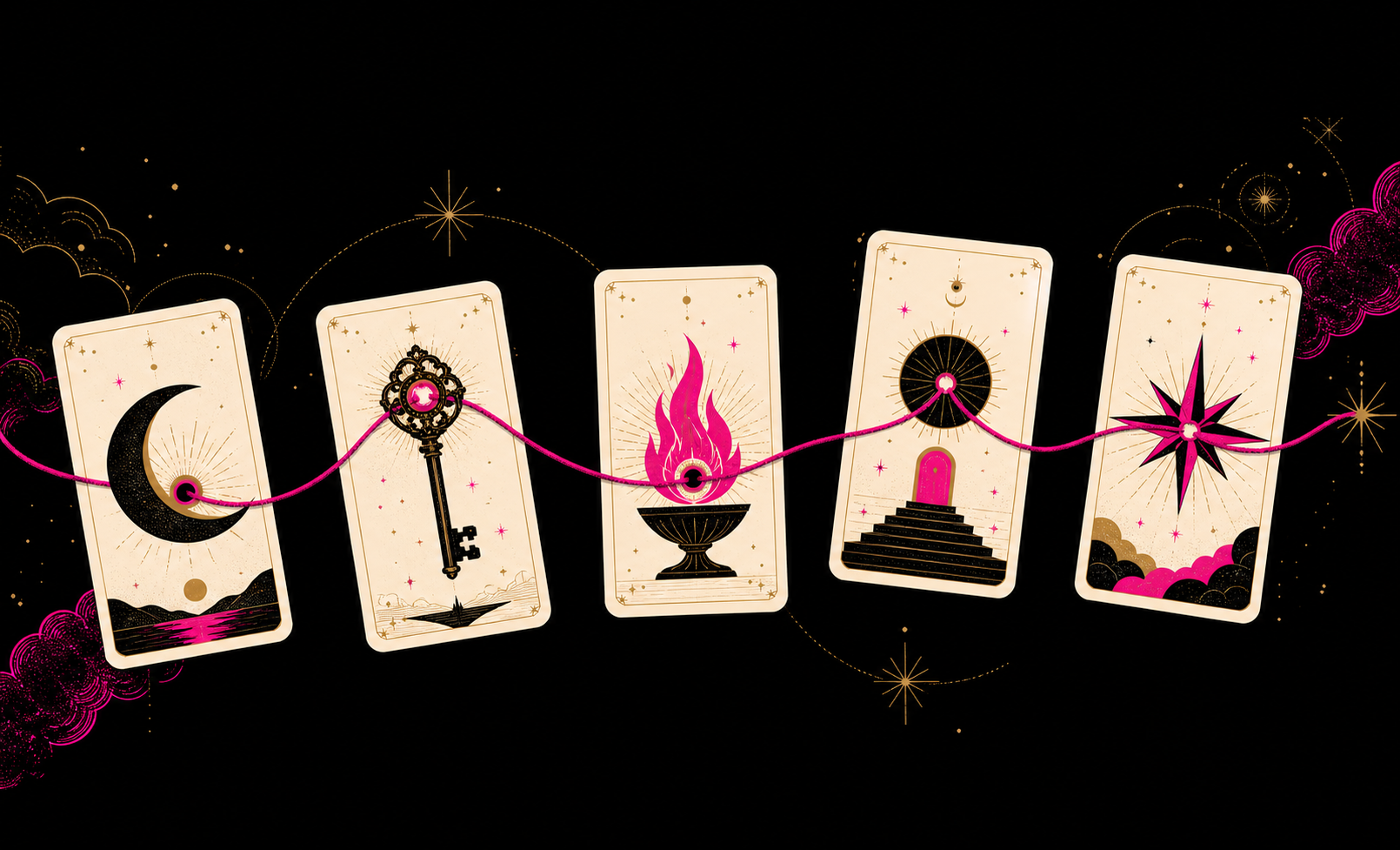
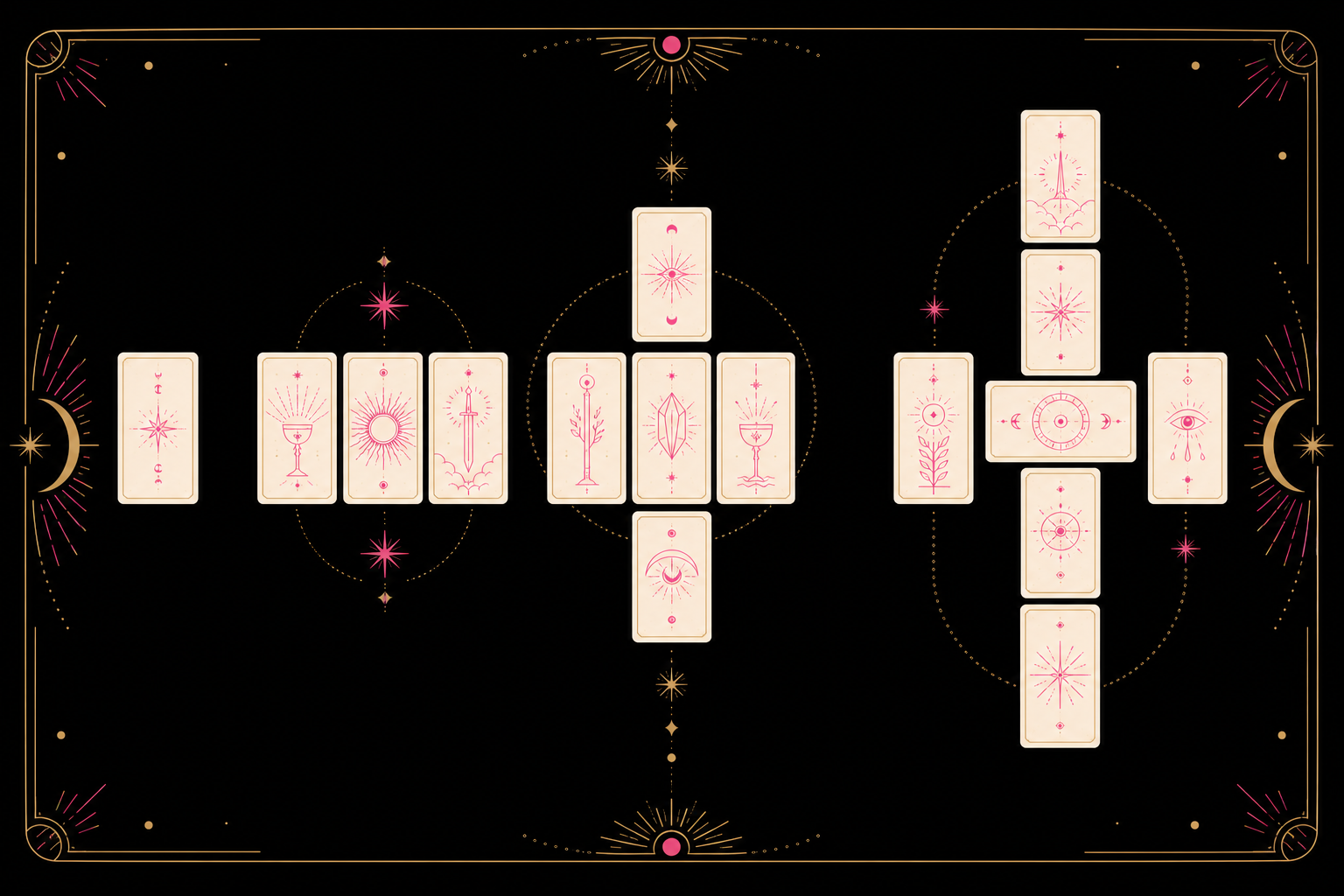
    Five cream tarot cards joined by a hot-pink thread, moving from a crescent moon through a key and flame to a star.

    No Major Arcana cards does not mean your reading has failed, your deck is sulking, or the universe has put you on hold. It usually means the useful stuff is closer to ground level.

    When no Major Arcana cards appear in a tarot spread, it can feel oddly underwhelming. Perhaps you asked a big question about work, love or a decision that is keeping you awake at 3am, then drew nothing but Minor Arcana and court cards. Before you reshuffle in a huff, take a breath. The Minor Arcana deals in the moving parts of ordinary life: habits, conversations, pressures, opportunities, practical choices and emotional weather. A reading without Major Arcana may be asking you to look at what you can actually handle, adjust or say next.

    What no Major Arcana cards actually mean

    The Major Arcana are the 22 archetypal cards in a standard tarot deck, from the Fool to the World. They are often associated with big inner shifts, turning points, long-running lessons and moments that feel larger than a single Tuesday afternoon.

    The 56 Minor Arcana cards are not the boring understudies. They give a reading its texture. They speak through the four suits: Wands for energy, desire and action; Cups for feelings and connection; Swords for thought, communication and conflict; and Pentacles for work, money, health, home and material reality. Court cards can describe people, roles, approaches or qualities you are being asked to develop.

    So, when no Major Arcana appears, a sensible interpretation is that the question may be best approached through daily-life details rather than a grand personal myth. You may not need to find your destiny. You may need to send the email, check the budget, stop rereading a vague text, take a proper break or have the mildly awkward conversation.

    No Major Arcana is not a verdict on your question

    A spread without Major Arcana does not prove that your question is unimportant. A difficult tenancy issue, a draining friendship or a job that is making you miserable matters, whether the Tower appears or not. Tarot card types do not rank your life experiences by seriousness.

    Nor does an all-Minor spread mean nothing meaningful is happening. It simply gives you a different lens. Instead of asking, “What monumental lesson is this?”, try, “What is going on here in practical terms, and where do I have room to act?” That is not less spiritual. It is often more useful.

    Why no Major Arcana cards appear in a spread

    First, cards are cards. A well-shuffled 78-card deck will sometimes produce a spread with no Major Arcana. There are only 22 of them, and a small spread can easily contain none. Tarot is a reflective practice, not a machine designed to provide a dramatic card whenever life feels dramatic.

    Second, the spread itself might be more suited to Minor Arcana territory. A three-card check-in about a meeting, a new routine or how to handle a tense week is likely to benefit from specific, grounded information. The cards may highlight the logistics and patterns that are shaping the situation right now.

    Third, you may be asking a broad question that needs narrowing. “What will happen in my career?” can produce a pile of practical cards because your next move depends on details: your workload, skills, finances, boundaries, confidence or the actual role available. The spread may be inviting a better question, rather than offering a cinematic answer.

    No Major Arcana can bring attention back to your agency

    It is tempting to treat Major Arcana as proof that a reading is deep and Minor Arcana as proof that it is merely administrative. Frankly, that is a bit backwards. Most change is built through repeated ordinary decisions. The Eight of Pentacles can matter enormously if you are learning a skill. The Two of Swords can matter enormously if avoiding a decision is exhausting you. The Five of Cups can matter enormously if you are grieving something real.

    A no Major Arcana reading can put the focus where it belongs: on your choices, resources and next honest step. It does not remove uncertainty, but it can stop you handing all your power to a deck of cardboard.

    How to read a tarot spread with no Major Arcana

    Read the spread as a whole before reaching for individual card meanings. With no Major Arcana present, patterns in suit, number, court cards and imagery often do the heavy lifting. You are looking for the situation’s mechanics: what is feeding it, what is stuck, what is available and what needs your attention.

    Read the suits when no Major Arcana appears

    Notice which suit dominates. A spread heavy in Cups may point to feelings, attachment, care, disappointment or relationship dynamics. Lots of Swords can suggest overthinking, difficult conversations, decisions or mental strain. Pentacles may bring the issue back to money, time, physical wellbeing, home or work. Wands can show momentum, ambition, impatience, creativity or burnout.

    For example, if you ask whether to take on a new project and draw the Ten of Wands, Two of Pentacles and Four of Swords, you do not need a Major Arcana card to get the point. The practical question is whether your capacity matches the demand. The answer may be to renegotiate the workload, delay the start, ask for help or decline. None of those options require a thunderbolt from above.

    Use numbers and court cards in a no Major Arcana reading

    Repeated numbers offer another clue. Several Twos may centre balance, choices or negotiation. Fives can highlight friction, instability or a necessary adjustment. Nines may point to something nearing maturity, whether that means completion, weariness or taking stock. Treat these as prompts, not fixed codes carved into a mystical paving slab.

    Court cards deserve particular attention. They may reflect a person involved, but they can also describe a role you are playing or a quality worth trying on. The Queen of Swords might suggest clear communication and good boundaries. The Page of Pentacles might suggest learning, research and a realistic beginner’s mindset. Ask which interpretation fits the evidence, rather than deciding every court card is definitely your ex’s new partner. That road rarely leads anywhere useful.

    Boss Witch Reality Check: A tarot spread is not a substitute for professional support with legal, financial, medical or mental health concerns. Use the cards to organise your thoughts, then speak to a qualified person where the stakes are high.

    Turn no Major Arcana into a practical question

    Once you have identified the pattern, pull the reading back to real life. If the cards show conflict, ask what conversation needs preparing. If they show scarcity, ask what information or support you need before making a choice. If they show exhaustion, ask what can be postponed, delegated or done less perfectly.

    You can also pull one clarifier, but do not keep drawing until a Major Arcana turns up and tells you something grander. That is not clarification. That is fishing. Write down the first spread, name one theme and choose one action that is within your control this week.

    When a no Major Arcana reading feels significant

    There are times when an all-Minor spread feels unusually apt. Perhaps you have been waiting for external permission to make a decision that is, in truth, yours. Perhaps you are trying to solve a practical problem by searching for a perfect sign. Or perhaps the situation is still developing and there simply is not enough information to make a sweeping conclusion.

    In those moments, no Major Arcana can be a useful cue to slow down and deal with what is knowable. Look at the facts, the people involved, the available money and time, your boundaries and your actual energy level. You are allowed to want meaning, but you are also allowed to need a spreadsheet.

    If the same Minor Arcana theme keeps returning across several readings, pay attention to the pattern in your life rather than treating the repetition as a prediction. Repeated Sevens of Swords might prompt an honest look at avoidance, incomplete information or trust. Repeated Four of Pentacles might make you consider where fear is making you grip too tightly. The value is in the reflection and the response you choose.

    What no Major Arcana does not mean

    It does not mean you should dismiss the reading. It does not mean a big life change cannot happen. It does not mean you are doing tarot badly, spiritually blocked or somehow less worthy of insight. And it certainly does not mean you need to buy another deck because this one has failed to provide sufficient drama.

    It also does not mean the Minor Arcana gives definite answers. Tarot can help you notice a pattern, explore options and articulate what you already sense. It cannot guarantee whether someone will text back, whether a job offer will arrive or whether a choice will work out exactly as planned. Keep your feet on the floor while you read.

    If a reading leaves you more anxious, compulsively pulling cards or unable to make a normal decision without checking the deck, put it away for a while. Make a cup of tea, talk to someone sensible and return when you can use the cards as a tool, not a tribunal.

    Boss Witch Takeaway: after no Major Arcana cards

    When no Major Arcana appears, write one sentence that names the most obvious practical theme in the spread. Then take one action within 48 hours that responds to it.

    For a Swords-heavy reading, that might be drafting the message you have been avoiding. For Pentacles, it could be checking your bank balance or booking an appointment. For Cups, it might be admitting what you feel to yourself before deciding what to share. For Wands, it could be choosing one task and starting before motivation turns into another elaborate procrastination hobby.

    FAQ: no Major Arcana cards in tarot

    Is no Major Arcana in a tarot reading a bad sign?

    No. It usually means the reading is focused on everyday circumstances, choices and patterns rather than broad archetypal themes. Minor Arcana cards can still offer sharp, relevant insight.

    Should I reshuffle if no Major Arcana cards appear?

    Not automatically. Read the spread you have first. Reshuffling simply because you expected a Major Arcana card can make it harder to hear the practical message already on the table.

    Can no Major Arcana cards still make a useful reading?

    Absolutely. Look at suit patterns, repeated numbers, court cards and the positions in your spread. These details can help you identify a concrete next step or a situation that needs a more honest look.

    What if no Major Arcana appears in every reading?

    It may simply be chance, especially with small spreads. If you notice recurring Minor Arcana themes, reflect on the real-life pattern they bring up, but avoid treating the absence of Major Arcana as a coded warning.

  • How to Read Multiple Tarot Cards as One Story

    How to Read Multiple Tarot Cards as One Story

    Knowing individual card meanings is only the beginning. A reading comes alive when you stop treating each card like a separate definition and start noticing the story they create together.

    Begin with your first impression

    Before reaching for a guidebook, look at the spread. Does it feel calm, tense, hopeful, heavy or fast-moving? Which card grabs your attention? Your immediate response is not the entire interpretation, but it is valuable information.

    Respect the positions

    A card answering “what helps me” behaves differently from the same card answering “what challenges me.” Read the card through the job you gave that position.

    Find the visual movement

    Notice where figures look, point or travel. Do two cards appear to face one another? Is a figure walking away from the rest? Does the scenery move from darkness into light? These details can reveal connection, avoidance, momentum or tension.

    Look for patterns

    A run of Cups emphasises emotions and relationships. Swords bring thoughts, communication and conflict. Wands speak of energy, ambition and action, while Pentacles ground the reading in work, money, the body and practical reality.

    Repeated numbers, court cards or elemental energies deserve attention. Several Major Arcana cards can indicate that the reading concerns a larger life lesson.

    Identify the turning point

    In a three-card spread, the middle card often shows the hinge of the story. Ask how card one becomes card three. What choice, realisation or action does card two introduce?

    Use connecting words

    Try saying the reading aloud using “because,” “but,” “therefore” and “if.” For example: “I am holding tightly because I fear instability, but a new opportunity asks me to act; therefore I need a plan that creates safety without keeping me stuck.”

    This transforms three keywords into one coherent message.

    Do not force every symbol

    You do not need to explain every colour, number and object. Choose the details that genuinely support the question and the pattern you can see. A clear reading is more useful than an impressive-sounding one.

    End with an empowered takeaway

    Summarise the reading in two sentences: what is happening, and what can you do with that knowledge? Tarot should leave you with perspective and a next step, not make you feel trapped by a prediction.

    Practise with a three-card spread, then use the tarot meanings library to deepen your understanding without losing the story.

  • What Does It Mean When You Get Lots of Major Arcana Cards?

    What Does It Mean When You Get Lots of Major Arcana Cards?

    You turn over your cards and the reading is full of Major Arcana. The Fool. Strength. Death. The Star. It immediately feels bigger than an ordinary daily check-in — and usually, it is.

    Major Arcana represent the bigger lessons

    The 22 Major Arcana cards describe major archetypes, transitions and chapters of human experience. They often appear when a situation is tied to identity, purpose, growth or a turning point rather than a passing inconvenience.

    That does not mean disaster or destiny has arrived. It means the reading may be asking you to look beyond the surface details.

    The balance matters

    One Major Arcana card among several Minor Arcana cards may act as the headline, with the surrounding cards showing how that theme plays out day to day. When most of the spread is Major Arcana, the period can feel less negotiable: something significant is asking for your attention.

    You still have agency. The cards describe the lesson and the energy, not a fixed script you are forced to perform.

    Look at the sequence

    Major Arcana are numbered from The Fool at zero through to The World at 21. Earlier cards can suggest initiation, experimentation and the formation of personal power. Later cards often deal with surrender, transformation, perspective, awakening and completion.

    If several appear, read them as stages of one journey. What begins the process? Where is the challenge? What kind of integration is being requested?

    Notice repeated themes

    The Emperor, Justice and Judgement may raise questions about authority, accountability and decisions. The High Priestess, The Moon and The Hermit might emphasise inner knowledge, uncertainty and withdrawal. Death, The Tower and The World can point to endings that clear space for a new chapter.

    What should you do next?

    Slow down. Journal the reading before pulling more cards. Ask which theme feels most alive in your real circumstances and identify one grounded action that honours the message.

    You can explore every card in the tarot meanings library. Compare the Major Arcana with the practical, everyday energy of the Minor Arcana to understand why the balance of your reading matters.

  • How to Ask Tarot Better Questions

    How to Ask Tarot Better Questions

    A powerful tarot reading begins before you draw a card. The question shapes the reading: vague questions tend to produce vague guidance, while questions built around your own choices create something you can actually use.

    Move from prediction to perspective

    “Will this definitely happen?” places all the power outside you. Try asking what is influencing the situation, what you need to understand, or how you can respond with confidence.

    Instead of “Will I get the job?” ask: “What can I do to present myself powerfully?” or “What should I understand about this opportunity?”

    Keep yourself at the centre

    Questions about somebody else’s hidden thoughts can pull you into guessing. Bring the focus back to the information that belongs to you.

    Instead of “Why are they ignoring me?” try: “What do I need to understand about this dynamic?” or “What boundary would protect my peace here?”

    Ask one question at a time

    If you ask about your ex, your career, your finances and the next six months in one breath, the cards have no clear framework. Separate the issues. One focused reading will usually give you more than a sprawling one.

    Use open questions

    Helpful beginnings include:

    • What do I need to understand about…?
    • What energy am I bringing to…?
    • What am I not seeing clearly?
    • What would support me now?
    • What is my most empowered next step?
    • What pattern am I ready to change?

    Avoid questions that remove your agency

    Tarot is at its best as a mirror, not a command. You remain responsible for your relationships, money, health, career and safety. Let the cards reveal patterns and possibilities, then combine that insight with evidence, conversation and practical action.

    Write the question down

    Putting the question into words exposes vagueness immediately. Write it at the top of the page, choose a suitable tarot spread layout, and record your first response before looking up every traditional meaning.

    If you want to practise, visit Tarot Readings. The love reading and career reading can offer a focused starting point.

  • Three-Card Tarot Spreads: More Than Past, Present and Future

    Three-Card Tarot Spreads: More Than Past, Present and Future

    Three cards can tell a surprisingly complete story. The layout is quick enough for a regular practice, spacious enough for intuition and structured enough to stop a reading from drifting.

    Past, present and future is only one way to use it. Give the positions a purpose before you shuffle, and the same three-card shape can answer dozens of different kinds of questions.

    Past, present and future

    Card one shows an earlier influence, card two describes the energy operating now and card three reveals where the current pattern may lead. The future card is not an unchangeable verdict. Treat it as a direction based on the energy and choices already in motion.

    Situation, obstacle and advice

    This is one of the clearest practical layouts. The first card names what is really happening. The second highlights friction, a blind spot or the belief keeping you stuck. The third suggests the most useful response.

    You, them and the connection

    For a relationship question, card one can explore your position, card two the other person’s energy and card three the dynamic being created between you. Keep the focus ethical: tarot can help you understand a connection, but it cannot grant access to somebody else’s private thoughts.

    Mind, body and spirit

    Use this spread as a personal check-in. What is occupying your thoughts? What is your body communicating? What does your deeper self need? It is especially useful when you feel “off” but cannot yet name why.

    Option A, option B and your deciding factor

    Tarot does not have to choose for you. Card one explores the energy around one route, card two explores the other and card three reveals the value, need or practical truth that should guide your decision.

    Release, reclaim and rise

    This empowering layout asks: what am I ready to stop carrying, what power or quality am I reclaiming, and what becomes possible when I act from that place?

    Reading the cards as one message

    Begin with each position, then zoom out. Notice whether the cards move from difficult to lighter energy, whether one suit dominates, whether several Major Arcana cards make the reading feel significant, or whether repeated numbers and symbols link the images.

    Pay attention to the middle card. It often behaves like a bridge: the choice, tension or shift connecting the first card to the third.

    When to pull a clarifier

    Pull another card only when you can state exactly what needs clarification. “What aspect of this obstacle am I missing?” is useful. Repeatedly drawing until the deck gives you the answer you wanted is not clarification; it is negotiation.

    Try your own three-card reading

    Choose your positions, write them down and ask one clear question. Let the cards build a story rather than treating them as three unrelated definitions. You can use our three-card tarot reading or browse the complete tarot meanings library as you practise.

  • Tarot Spread Layouts: Which One Should You Use?

    Tarot Spread Layouts: Which One Should You Use?

    Tarot spreads do not need to be complicated to be powerful. A spread is simply a layout that gives each card a job. It creates enough structure to keep your reading focused while still leaving room for intuition.

    The best layout is not necessarily the biggest one. It is the one that matches the question you are actually asking.

    One-card readings

    A single card is perfect when you want clarity without overwhelm. Ask what energy surrounds the situation, what you need to understand, or where your attention would be most useful today.

    One card is not a lesser reading. Learning to stay with one image and explore it properly can be far more revealing than pulling half the deck because you disliked the first answer.

    Three-card spreads

    The three-card spread is the most versatile tarot layout. Past, present and future is the familiar version, but the positions can represent almost anything: situation, obstacle and advice; mind, body and spirit; you, them and the connection; option A, option B and what matters most.

    Three cards create a beginning, middle and end, making it easier to see how the cards speak to one another. Read our full guide to three-card tarot spreads for layouts you can use straight away.

    Five-card spreads

    Five cards allow more detail without becoming unwieldy. Try: the heart of the matter, what supports you, what challenges you, what you cannot yet see and your most empowered next step.

    This layout works especially well when a situation has several moving parts and a three-card spread feels too compressed.

    The Celtic Cross

    The Celtic Cross is a classic ten-card spread covering the current situation, challenges, foundations, recent influences, possibilities, near future, your position, your environment, hopes or fears and a likely direction.

    It can be brilliant for a broad life overview, but it is not automatically the right choice for every question. If you want one clear decision, ten cards may create more noise than insight.

    Relationship and career layouts

    Topic-specific spreads help you ask sharper questions. A relationship spread might explore your needs, their energy, the dynamic between you, what requires honesty and the healthiest way forward. A career spread could cover your strengths, present obstacle, unseen opportunity, practical action and longer-term direction.

    Tarot should support your agency. It does not make another person’s decisions for them, guarantee an outcome or replace practical action.

    How to choose your spread

    Start with the question, then choose the fewest cards needed to explore it properly. If the question is precise, use one or three cards. If it involves several influences, try five. Use a larger layout when you genuinely want a wide-angle view.

    Before drawing, write down what every position means. This prevents you from changing the rules halfway through because an uncomfortable card appeared.

    Explore the tarot meanings library when a card needs closer attention, or visit Tarot Readings to try an interactive reading.

  • Four of Swords Tarot Card Meaning

    Four of Swords Tarot Card Meaning

    Rest before your body makes the appointment for you.

    UPRIGHT

    Pause, recover and let a busy mind become quiet enough to hear itself.

    REVERSED

    Burnout, avoidance or restlessness may be asking for honest attention.

    What the Four of Swords is really trying to tell you

    The Four of Swords tarot meaning is not “give up” and it is not a gold star for being too knackered to move. It is a practical instruction: pause on purpose. Your mind, body or circumstances need a little less input and a little more room to recover.

    This card often appears after tension, conflict, overthinking or a demanding stretch of life. You may have been holding things together, making decisions, managing people’s expectations or simply trying to get through the week without becoming a small ball of static. The Four of Swords says that rest is part of the work. It is not something you earn only after collapse.

    That does not necessarily mean quitting your job, cancelling every plan or disappearing to a cottage with no Wi-Fi. It can mean taking a proper lunch break, putting your phone in another room, delaying a non-urgent decision, sleeping more, or giving yourself an evening where nobody gets access to you. The point is to interrupt the cycle long enough to regain perspective.

    Traditional symbolism and what it means

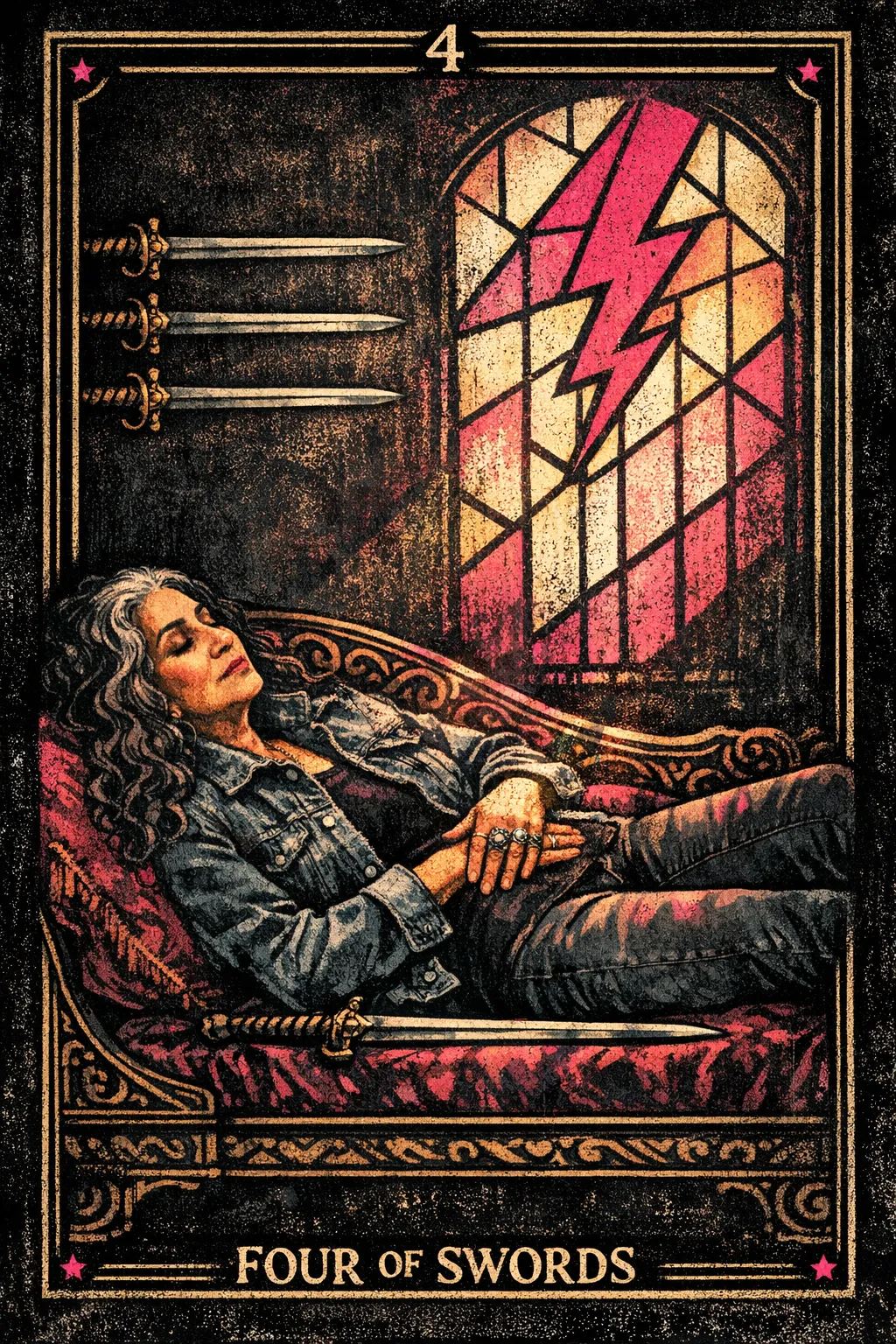
    In the classic Rider-Waite-Smith image, a figure lies on a tomb or stone bed with hands held in prayer. Three swords hang above them and a fourth rests below. A stained-glass window appears in the background, bringing a small note of colour and meaning to an otherwise quiet scene.

    • The resting figure represents retreat, recovery and a necessary withdrawal from noise. This is chosen stillness, not failure.
    • The three swords above can suggest the thoughts, stresses or conflicts that remain present, even when you are resting. Your problems have not vanished, but they do not need to sit on your chest all night.
    • The sword below points to a mind set aside. It is the pause between action and the next clear decision.
    • The stained glass hints at reflection, faith and a wider perspective. Quiet can help you notice what mattered beneath the drama.

    The image looks solemn because recovery is sometimes serious business. If you have ignored your limits for months, a scented candle and a face mask may be lovely, but they are not a full strategy. This card asks for the kind of rest that actually changes your capacity.

    Upright Four of Swords meaning

    Upright, the Four of Swords points to rest, healing, contemplation and mental quiet. It suggests that the most useful next move may be no move at all, at least for a short while. Step away from the argument, the frantic search for answers or the pressure to respond immediately.

    This is especially relevant when you have been in survival mode. Your nervous system may be treating every email as a fire and every unanswered text as a tribunal. A pause helps separate what is genuinely urgent from what merely feels loud.

    The card can also indicate a period of private planning. You do not need to announce every thought while it is still tender and half-formed. Rest, gather information and let your next decision mature. Silence can be protective without becoming secrecy.

    Reversed Four of Swords meaning

    Reversed, the Four of Swords often flags restlessness, burnout or a refusal to stop. You may be telling yourself that you are fine while your sleep, concentration, temper or body is offering a rather different review. The card is not here to shame you. It is here to make the cost visible.

    Sometimes the reversal means you have rested long enough and are becoming stuck in avoidance. A difficult conversation, application or decision may not improve because you keep waiting to feel perfectly ready. Rest should restore you, not become a hiding place with excellent snacks.

    Ask which version fits. Are you pushing through when you need care, or withdrawing when you need a small brave step? The answer is usually in the practical evidence: your energy levels, your calendar, your bank balance, your sleep and the task you keep circling.

    Love and relationships

    In love readings, the Four of Swords suggests space to think and breathe. If a relationship has been tense, it may be wise to cool down before trying to solve everything at 11.40pm while both of you are tired and cross. A pause is not automatically rejection. It can be a respectful way to stop a disagreement becoming cruel.

    If you are single, this card may reflect a period of emotional recovery or a wish to be more selective. You do not need to date just because your mates have opinions about your sofa, your age or your allegedly “wasted” weekends. Take stock of what you want, what you can offer and which old patterns deserve to stay in the past.

    Reversed, it can point to avoidance, emotional shutdown or carrying old hurt into every new interaction. Give yourself compassion, but also notice whether you are asking someone to guess needs you have not communicated. A calm, clear sentence can do more than three days of anxious analysis.

    Career and work

    For career and work, the Four of Swords asks you to protect your mental bandwidth. You may need time away after a big project, a stressful meeting, redundancy worries or a period of carrying too much. If leave is available, consider using it. If it is not, look for smaller boundaries that are actually within your control.

    Try blocking a focused hour, declining a meeting without an agenda, taking your full break, or writing tomorrow’s priorities before you log off. This card supports strategic pause. Good ideas often arrive after you stop trying to squeeze them out under fluorescent lighting.

    Reversed, it warns against chronic overwork or procrastination dressed up as preparation. If your workload is unreasonable, document it and raise it with the relevant person. If you are delaying a manageable task, break it into one unattractive but doable first step. Neither martyrdom nor avoidance deserves a promotion.

    Money

    The Four of Swords is not a dramatic money card, which is partly its value. It recommends a pause before financial decisions made from panic, boredom or exhaustion. Avoid late-night online shopping, rushed investments and agreeing to costs you have not had the energy to read properly.

    Upright, take a quiet look at your accounts, subscriptions and upcoming bills. You do not have to fix your entire financial life in one sitting. One calm review is more useful than doom-scrolling your banking app. Reversed, the card can highlight financial stress that has been ignored because it feels overwhelming. Choose one concrete action, such as opening the letter, checking the balance or contacting a provider about a payment plan.

    Personal growth and spiritual meaning

    Spiritually, the Four of Swords is about creating enough quiet to hear your own thoughts. That may involve meditation, prayer, a walk without a podcast, journalling, therapy, a nap, or sitting in the car for five minutes before going inside. It does not require a perfect morning routine or expensive linen trousers.

    The deeper lesson is that your worth is not measured by output. Rest can reveal how much of your busyness comes from genuine responsibility and how much comes from fear of disappointing people. Tarot cannot make that choice for you, but it can hold up a useful mirror while you decide what needs to change.

    Boss Witch Reality Check

    You cannot organise your way out of depletion if the real problem is that you are trying to do the work of three people with the recovery time of a Victorian chimney sweep. The Four of Swords does not ask you to become passive. It asks you to stop treating your limits as a character flaw.

    Look at the facts. What has been draining you? What can wait 24 hours? What needs a boundary, a conversation, professional support or a practical change rather than another pep talk? Be kind to yourself, then be honest. Both are required.

    Boss Witch Journal Prompt

    If I stopped proving that I can cope for one week, what would I need to admit, ask for or change?

    Boss Witch Challenge

    Choose one evening this week and protect a 60-minute no-input reset. Put your phone on silent in another room, do not work, do not research your problems and do not use the time to catch up on chores. Eat, bathe, stretch, stare out of the window or sleep. Afterwards, write down the one task that truly needs your attention tomorrow.

    Boss Witch Reminder

    Pausing does not mean you are falling behind. It means you are giving yourself a fair chance to continue without breaking the bits of you that have carried everyone else.

    Frequently asked questions

    Is the Four of Swords a yes or no card?

    It usually suggests “not yet”. Pause, gather yourself and revisit the question when you have more clarity.

    Does the Four of Swords mean a breakup?

    Not necessarily. It more often points to space, recovery or a need for calmer communication before deciding what comes next.

    What does the Four of Swords reversed mean?

    It can indicate burnout, anxious restlessness or avoidance. Check whether you need genuine recovery or a small action you have been delaying.

    What should I do when I draw the Four of Swords?

    Reduce unnecessary noise, delay non-urgent decisions and make one realistic plan for rest that your actual life can support.

    Related cards

    The Three of Swords is worth exploring when the Four of Swords follows heartbreak, conflict or mental strain. The Hermit also speaks to solitude and reflection, though it is more focused on seeking inner guidance. For the point where rest turns into renewed movement, look to the Ace of Swords, a card of clarity, truth and a clean mental beginning.

  • Two of Swords Tarot Card Meaning

    Two of Swords Tarot Card Meaning

    You do not need perfect certainty to make an honest decision.

    UPRIGHT

    A guarded pause asks for one missing fact and a clear choice.

    REVERSED

    Avoidance is cracking, and the decision can no longer sit quietly in the corner.

    What this card is really trying to tell you

    The Two of Swords appears when you are caught between options and trying very hard not to disturb the peace. You may be waiting for a sign, a better mood, another person to make the first move, or a level of certainty that real life rarely provides. The card is not calling you foolish. It is showing you that your pause has become a position.

    Its central message is blunt but useful: avoiding the decision is still a decision. Silence affects relationships. Delayed applications affect work. Not checking your bank balance affects money. The aim is not to make a flawless choice. It is to stop pretending that doing nothing is neutral when it is quietly costing you energy, time or self-respect.

    For the Two of Swords tarot meaning, look for the missing fact rather than more opinions. What do you actually need to know? Then choose the option you can explain to yourself without elaborate excuses. That is often the least dishonest option, and it is usually a decent place to begin.

    Traditional symbolism and what it means

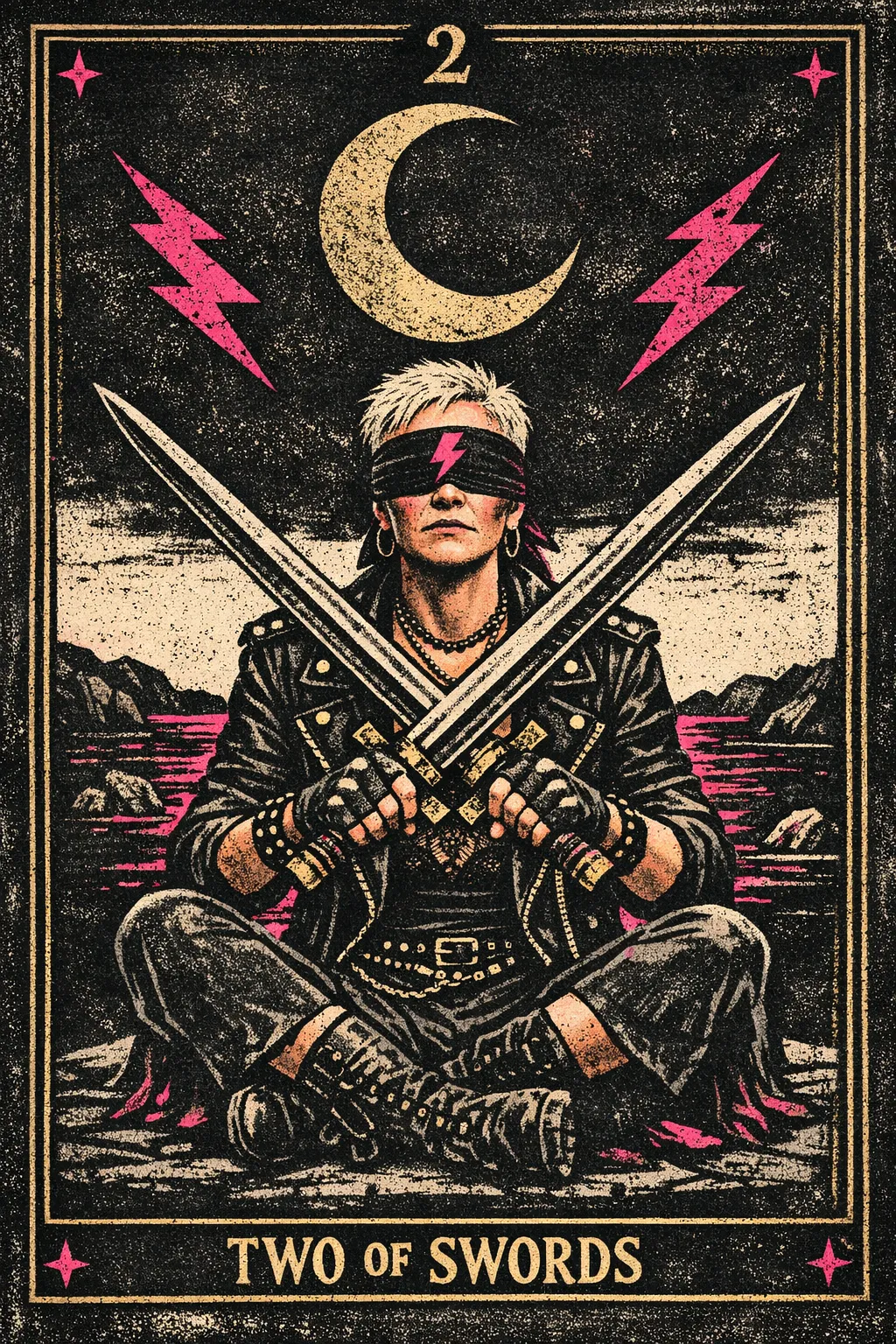
    In the traditional Rider-Waite-Smith image, a blindfolded figure sits with two swords crossed over their chest. Behind them are a rocky shoreline, a restless sea and a crescent moon. Nothing is exploding. That is important. This is not a crisis card so much as a card of contained tension.

    • The blindfold suggests incomplete information, denial or a wish not to see what is obvious. It can also be self-protection when the truth feels emotionally loaded.
    • The crossed swords show a stalemate. Both positions have merit, but holding them in balance takes effort and leaves little room to act.
    • The sea and rocks point to feelings running underneath a controlled exterior. You may look calm while internally doing the mental equivalent of pacing the kitchen at 2am.
    • The crescent moon brings intuition, uncertainty and things not yet fully revealed. It asks for patience, but not endless postponement.

    As a Minor Arcana card in the suit of Swords, the Two of Swords deals with thoughts, communication, boundaries and decisions. It is less about fate than the story you are telling yourself about your options. Check whether that story is accurate before you build a fortress around it.

    Upright meaning

    Upright, the Two of Swords signals a difficult choice, a temporary stalemate or a careful truce. You may be weighing two paths that both involve loss as well as possibility. It can show a boundary that is keeping things civil, particularly when emotions are raw. A pause is not automatically avoidance. Sometimes it is sensible to wait until you have the facts and can speak without turning the room into a bonfire.

    But this card has a time limit. Ask what the pause is for. If you are gathering information, regulating your emotions or making space for a fair conversation, good. If you are repeatedly re-reading messages, avoiding the email, or hoping a problem will dissolve because you have not looked directly at it, the Two of Swords wants a small act of courage.

    Reversed meaning

    Reversed, the Two of Swords often shows the stalemate breaking. This can feel relieving, messy or both. Information may arrive, a conversation may force the issue, or you may simply become too tired to keep holding two incompatible truths apart. The blindfold is slipping.

    It can also point to overwhelm. Too many opinions, tabs, voice notes and what-ifs can make a simple decision look like a parliamentary inquiry. Reduce the noise. Return to the actual question, name your non-negotiables and decide what can be revisited later. Not every choice needs to carry your entire future on its back.

    Love and relationships

    In love readings, the Two of Swords can indicate emotional guardedness, unspoken tension or a relationship sitting in an uneasy peace. Perhaps neither person wants to start the difficult conversation. Perhaps you are deciding whether to stay, define things, ask for more, or admit that what you need is not being met.

    Upright, give yourself permission to ask a direct question. Try: “I care about this, but I need clarity about where we stand.” That is not needy. It is adult. If you are single, the card may suggest you are comparing people from behind a protective wall, or still split between wanting connection and wanting complete safety. Both desires make sense. Be honest about which one is steering.

    Reversed, a truth may be difficult to ignore. Avoid guessing another person’s feelings from crumbs. Notice patterns, listen to their words, and decide based on the whole picture. Tarot can help you reflect, but it cannot replace a conversation or make someone communicate properly. Sadly, the cards have not yet invented that spell.

    Career and work

    At work, the Two of Swords often arrives when you are torn between two roles, two strategies or two ways of handling a conflict. You might be keeping your head down because office politics feel exhausting. Fair enough. Still, consider whether silence is protecting your peace or making it easier for someone else to decide on your behalf.

    Gather the useful evidence: job description, salary range, deadlines, workload, written expectations and your actual capacity. If a colleague is being vague, ask for specifics in writing. If you are considering leaving, update your CV before deciding that every option is impossible. Reversed, the card can flag decision fatigue, missed communication or a choice made under pressure. Slow the process where you can and put the facts somewhere visible.

    Money

    For money, this card suggests a choice that deserves numbers rather than vibes. It may be about whether to save or spend, pay off debt or build a buffer, accept an offer, split costs, or finally open the letter you have been avoiding. No shame here. Money admin can make even capable people want to hide under a blanket.

    Upright, avoid rushed commitments and get one missing figure before you act. Reversed, stop delaying the practical task. Check the due date, compare the options and contact the provider or adviser if needed. The Two of Swords does not promise a perfect financial result. It supports a more informed, less avoidant next move.

    Personal growth and spiritual meaning

    Spiritually, the Two of Swords asks you to balance intuition with evidence. Your gut matters, especially when it notices a pattern your logical mind keeps explaining away. But anxiety can also wear a dramatic hat and call itself intuition. Give both sides a fair hearing.

    This card can be a useful prompt for discernment. Sit quietly, write down the facts, write down the fears, then notice which statements belong in each column. You do not need to become fearless before making a choice. You need enough self-trust to act kindly and cleanly once you have made it.

    Boss Witch Reality Check

    Being “undecided” can sometimes be a polite cover for knowing the answer but not liking the consequences. If you already know that a situation is draining, unfair or incompatible with your values, more tarot pulls may only give you prettier ways to postpone it. Use the card as a mirror, not permission to hand your power to a deck.

    Boss Witch Journal Prompt

    What fact am I avoiding, and what choice would feel most honest if I stopped trying to keep everyone comfortable? Write for ten minutes without editing yourself. Then underline the one sentence that feels annoyingly true.

    Boss Witch Challenge

    Within the next 24 hours, send one clear message that gathers the missing information. It might be an email asking for a deadline, a text requesting a proper conversation, or a call to check a balance. Keep it to three sentences. Your job is not to solve everything. Your job is to remove one layer of the blindfold.

    Boss Witch Reminder

    You are allowed to take time before deciding. You are not required to stay frozen to prove that you are thoughtful. A clear, imperfect choice can be adjusted. Chronic avoidance just invoices you later.

    Frequently asked questions

    Is the Two of Swords a yes or no card?

    It is usually a “not yet”. More information, honesty or a direct conversation is needed before a useful answer appears.

    Does the Two of Swords mean someone is hiding feelings?

    It can suggest guarded emotions or unspoken thoughts, but it cannot confirm another person’s feelings. Look for communication and behaviour, not tarot certainty.

    What should I do when I draw the Two of Swords?

    Name the decision, identify one missing fact and set a sensible deadline for taking your next step.

    Is the reversed Two of Swords always bad?

    No. It can be uncomfortable because a stalemate breaks, but that movement may bring needed clarity and relief.

    Related cards

    If the Two of Swords has landed for you, the Justice card can help you weigh consequences and make a fair call. The Eight of Swords explores the thoughts and fears that can make your options seem smaller than they are. The Two of Pentacles is useful when your decision is less about conflict and more about managing competing practical demands.